
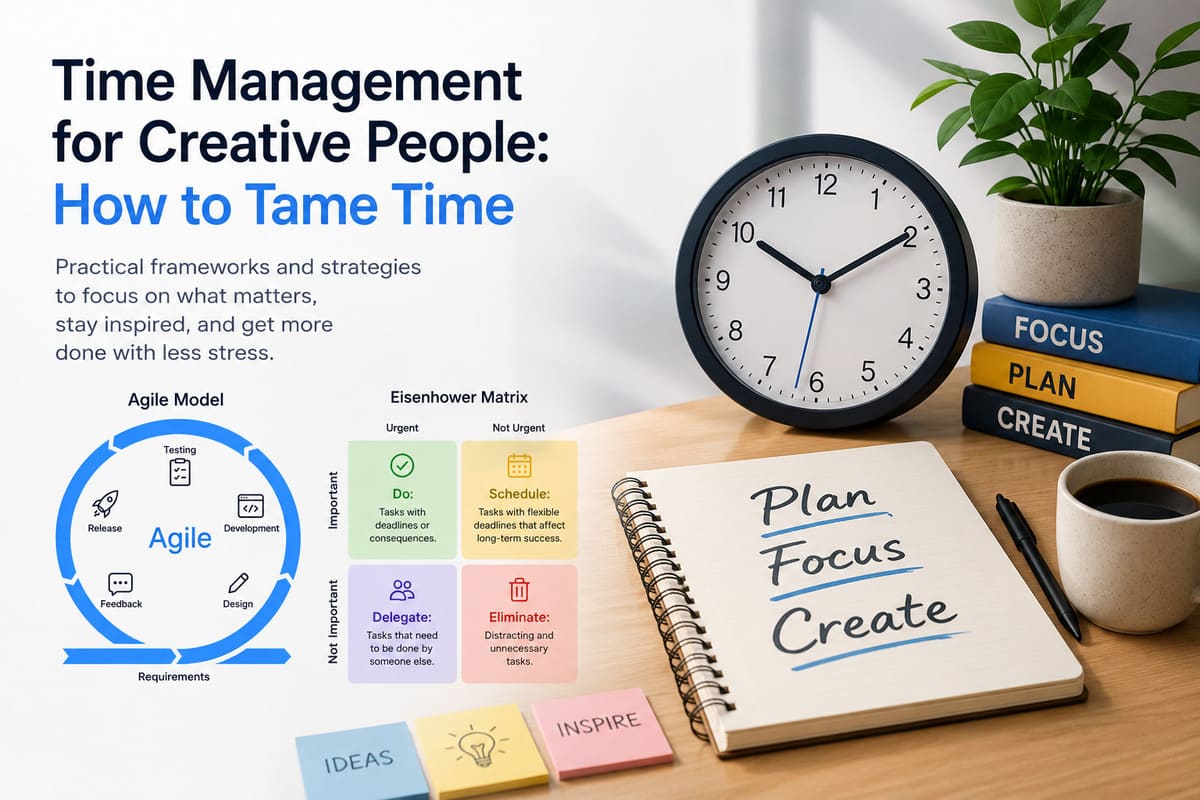
Time Management for Creative People: How to Tame Time
Friends, today we will try to figure out some nuances of how to tame time, which flies by so fast. After all, time management for creative people — meaning copywriters, bloggers, and so on — is at the very core of their work. Therefore, we have gathered here useful tips, principles, and software that will help you manage your time wisely.
Table of Contents
Time management for creative people
The first idea is like a flash. Sometimes, it forces you to jump up in the middle of the night and start sketching out a plot for a future commissioned text or a blog post. And after that — nothing. It seems like there is time. And there is desire. But the result is zero. Because, ultimately, minutes, hours, and sometimes entire days go the wrong way and toward the wrong things. Why? And how can you effectively resist this? Let’s figure it out together.
Too much is bad, and too little is also bad. This principle applies to ideas as well. Everything should be in moderation. Otherwise, time begins to work against you. What should you do? There is a different recipe for every situation.
The Mind — Like a Blank Slate
Sitting at your desk won’t make the text appear on its own, even after a stunning start. If the problem is a lack of creative energy, you need to accumulate it. And for this, you don’t need to simulate activity at the keyboard. I have already talked a bit about time management for creative people, how to get everything done, procrastination, and the struggle against it, but here is where to find new ideas and inspiration:
- Find new ideas and inspiration in ordinary things. Go shopping, spend time with family and friends, take a walk — live your life and don’t force yourself to think only about creativity. But don’t forget to bring a notebook, or better yet, a voice recorder (the one built into your smartphone will do just fine) — this way, an idea that suddenly drops into your head is guaranteed not to go anywhere.
- Changes are refreshing — it doesn’t necessarily have to be something global, like a trip or moving to a new home. You can move your workspace to another room or a cafe. Or at least change the wallpaper on your computer screen. New information activates neural connections.
- Spying is not shameful. People are an inexhaustible source of information. Some modern copywriters admit that, in case of a “mental block,” they head to the most crowded places — like a shopping mall or an airport — and simply watch and listen. Other people’s faces and conversations involuntarily inspire.
The Mind — Like a Full Pan of Popcorn
You haven’t even had time to pick up one fluffy kernel before another piece of popcorn “explodes” and draws your attention away. It can be much the same with ideas. It seems like there is time and a blank file. But the swarm of thoughts is so unsystematic that it forces you to jump from one topic to another. As a result, none of them end up fully developed. And for this case, there are also recipes.
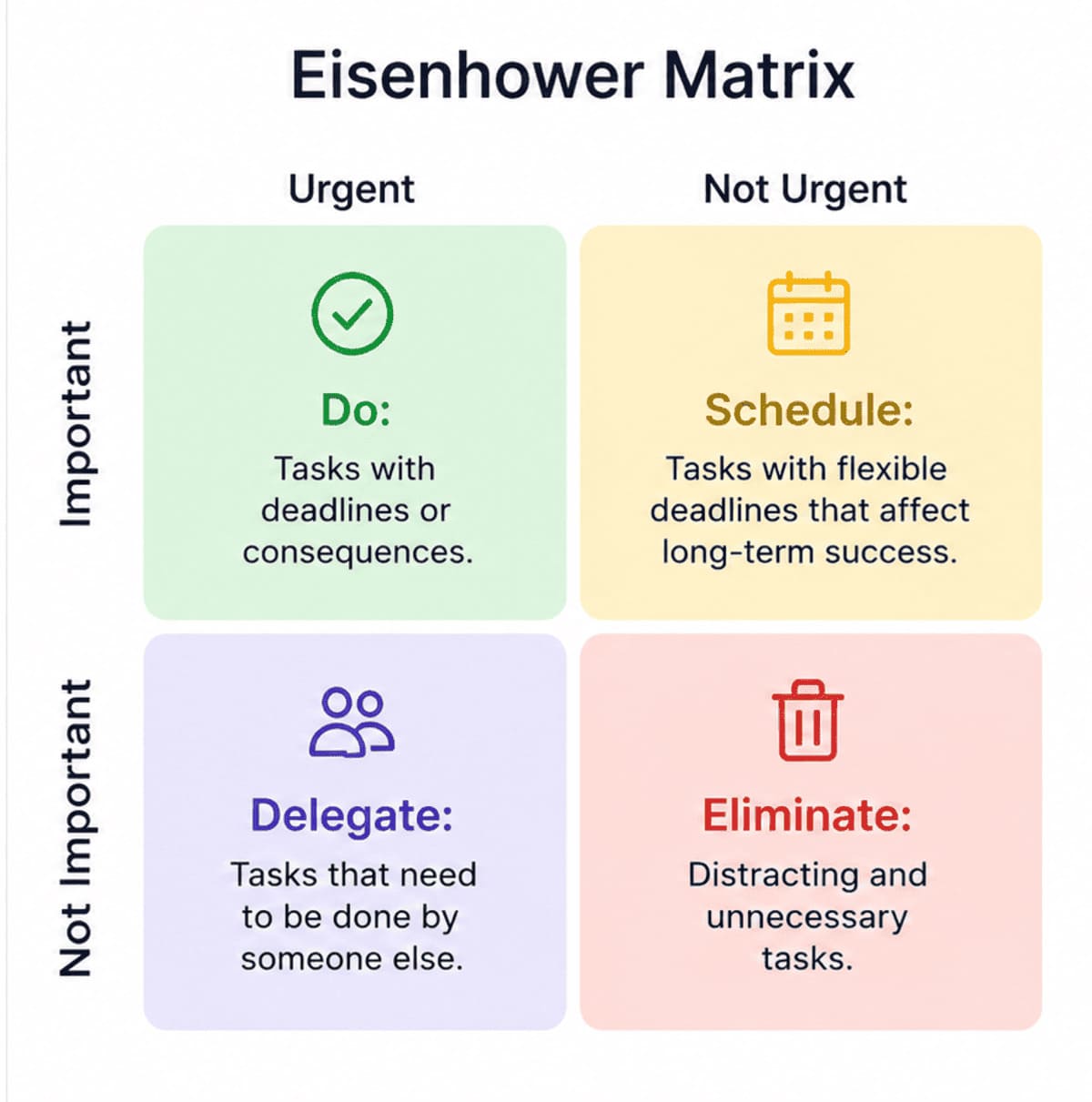
- The simplest time management for creative people is to write down all thoughts (tasks). Then, rank them by priority. The Eisenhower Matrix can help with this. A square is divided into four parts. Tasks within it are grouped into “important and urgent,” “important and non-urgent,” “unimportant and urgent,” and “unimportant and non-urgent.” This analysis makes it easy to understand where to start and what can be left for later. For example, adding a description for clothing that will soon be on sale is a task that might not be so important, but it is certainly urgent. But sketching out a plot for a text on a given topic according to a technical brief — that is important, but it can wait a bit. However, regularly reviewing and adjusting the matrix also takes time. And if you don’t monitor its contents, it loses its meaning.
- Breaking it down and celebrating is also a way out. Any large task that feels intimidating can be broken into many small ones. A “checkmark” next to each item works like a pat on the back for a copywriter’s psyche (and for anyone’s, really) — so you shouldn’t be ashamed to include even such trifles as “open file” in your to-do list — a tiny checkmark will give the brain big motivation.
- Nonetheless, even such long lists can drive some authors into a stupor. The solution — dictate the tasks to yourself. There is a voice recorder in every smartphone. After recording a task, you need to pause. Then — listen to them one by one. And do not play the next one until you have finished the previous one. Among the downsides — the inability to highlight urgent and important tasks, as tasks do not enter the brain in order of priority, which is a pity.
Getting into the Workflow
How do you get into a working mood? A single, correct time management for creative people simply does not exist in nature.
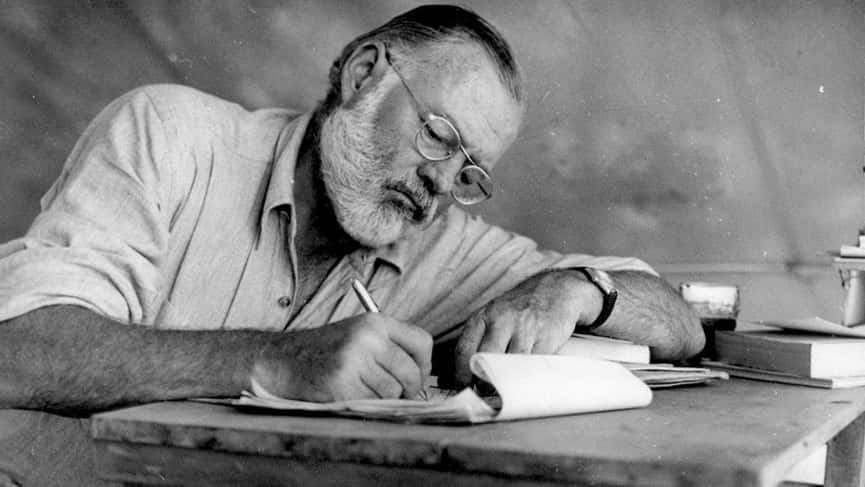
Ernest Hemingway worked strictly on a schedule, getting up at 6 a.m. regardless of when he went to bed. He counted the number of words written per day and built charts.

Haruki Murakami favored similar principles.
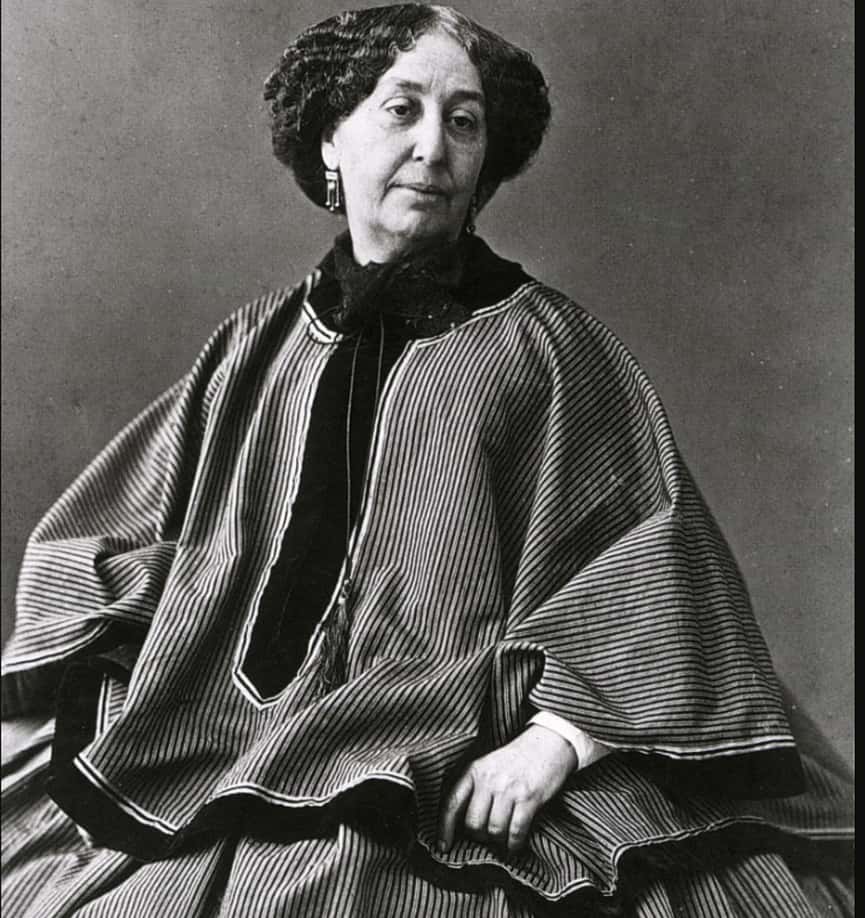
George Sand set a bar for herself at 20 mandatory pages per day. Not everyone is inclined toward such discipline.
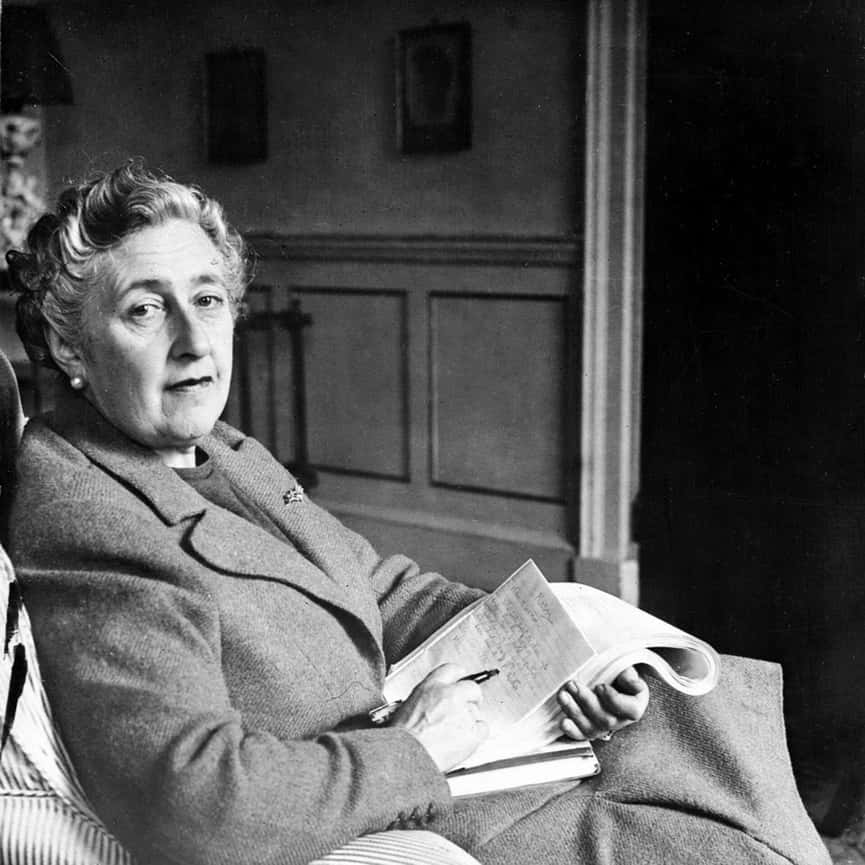
Agatha Christie, on the contrary, wrote in snatches between chores, not even having a desk.
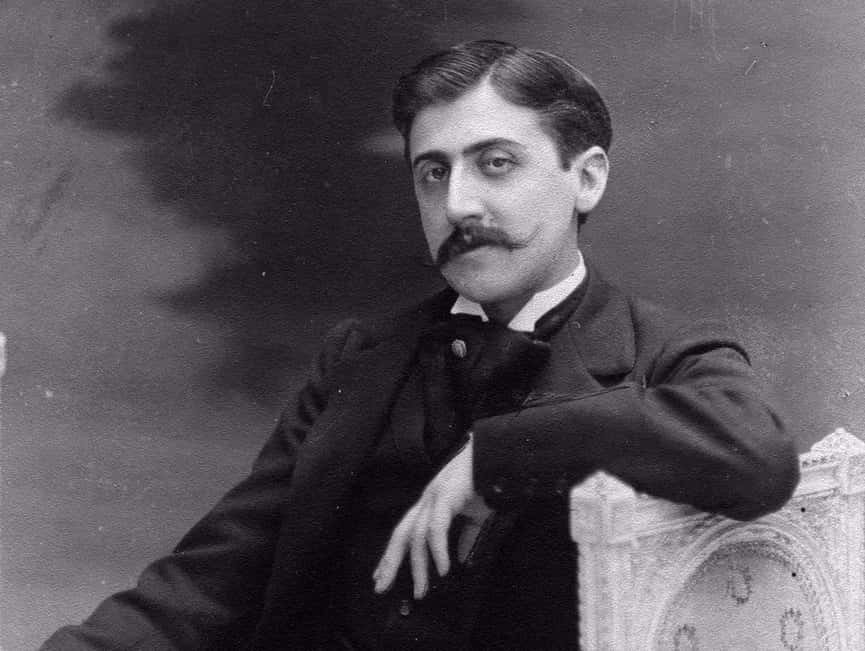
Proust generally believed that only physical suffering allows one to reach heights in art, so he avoided society and wrote at night, tormenting himself with a lack of sleep.
It is unlikely that anyone today is ready for that — health is more valuable. Besides, many have other jobs besides copywriting or blogging. However, life hacks appear regularly on copywriting forums and even more so on social media pages. For example, to get into a creative mindset, the following time management for creative people is recommended:
- Decide on a workspace — being present there will eventually start to automatically put your brain into the desired state.
- Define your workdays. If you are not only working online but are also a parent, a professional in another field, or a volunteer in an organization, do not try to combine all roles in one day. You can decide for yourself that Sunday is family day. Monday is for your main job. And another day (or part of it) is always time for creative work. Moreover, not only you but also those around you should know about this so that no one distracts you.
- Focus on quality, not quantity. Pareto’s Law states that 80 percent of efforts yield 20 percent of results — and vice versa. That is, it is not necessary to set aside several hours to complete a task; you need at least one, but during this time you must give it your all, without being distracted by cat memes, phone calls, etc.
- Leave the house. Coworking spaces with fast Internet, silence, cookies, and paid stays force you to get down to business.
- “Flip” the day: the morning is wiser than the evening — folk tales are right in many ways. First, in the morning, the head is clear and fresh. Second, at this time, others are usually busy and cannot distract you from work. And the temptation to run off to the cinema/cafe/for a walk is still small. This approach will allow you to be productive.
A Jack-of-all-trades — Writer, Worker, and Creator
If a profession is defined by one’s source of income, many who write in their spare time outside of their main job could be labeled as non-professionals. But this says nothing about the quality of their work. For instance, Bulgakov, Dahl, and Chekhov worked as doctors. Alexander Ostrovsky began creating his works while serving as a court clerk. Mikhail Prishvin was a talented land-use engineer. Examples of juggling multiple roles can be found among modern authors as well.
How can you get everything done? For some, setting aside specific “writing” days or evenings will help. For others — the skill of saying “no” to family and friends, because there is only enough time for everything at once — regular creativity, a full-time job, and unlimited leisure — if you give up sleep.
A solution could be applying the Agile methodology to your life. Its philosophy involves flexibility and the ability to adapt, the need to maintain a constant work pace (without “burnout” sprints or idle periods), and evaluating results at regular intervals. It is clear that there are emergencies at work, and children get sick. In such conditions, it is difficult to plan a rigid 5 pages per day — but you can set a goal of 50 pages over 2 weeks. Then, your conscience won’t bother you for an evening of idleness. After all, on some days, 30 pages might be born at once — if the inspiration is there.

Technology to the Rescue
You can draw matrices on a piece of paper or make lists in your smartphone’s “Notes.” Or, you can take advantage of technology and use it to manage your time. Here are the top 8 most convenient and effective programs that will help you set up the right time management for creative people — which one to choose is up to you:
| Name | Features | Platforms |
|---|---|---|
| Any.do | Tasks can be assigned priorities, tags, reminders, subtasks, and attachments. | Mobile, desktop, web. |
| Todoist | Allows creating tasks and subtasks and tracking a productivity chart. A free version is available. | Mobile. |
| Microsoft To-do | You can set recurring tasks and discuss them in “Conversations” with other users. | Mobile, desktop. |
| Google Calendar | The calendar automatically suggests deadlines for tasks and imports data from Gmail. | Mobile, web. |
| Trello | Allows creating a virtual board with tasks to better visualize your workload. | Mobile, web. |
| 2do | Allows synchronization with cloud storage and Siri. | Mobile. |
| Agnessa | A planner with a simple interface. | Mobile. |
| Timely | In addition to planning, it allows tracking time spent on websites, in apps, and on calls to evaluate work efficiency. | Mobile, desktop. |
With such tools, planning time will be easier for both a beginner copywriter and an experienced one. Ultimately, the amount of time spent does not determine the quality of the writing. For example, Anthony Burgess created “A Clockwork Orange” in 3 weeks. And Georges Simenon spent only 6 days on the first novel in the Inspector Maigret series.
So, a single time management for creative people does not exist. To each their own.